
Monthly Articles
Italy Gets 337 Stolen Artifacts Back From the U.S.
At a ceremony in Rome in late April, U.S. officials formally returned 337 looted antiquities, archival materials, and artworks to Italy. The objects range from the Villanovan era (900 to 700 B.C.E.) through the Hellenistic period and include sculptures, bronzes, ceramics, goldwork, and a marble head of Alexander the Great that was originally found in the Roman Forum. The Manhattan District Attorney’s office was behind 221 of the returned objects. The remaining 116 were recovered through a joint effort between the FBI, Homeland Security, and Christie’s on April 10. Among them are bronzes and terracottas from the Iron Age, a vase from the ancient Greek colony of Canosa di Puglia, and a cache of Roman coins.
This year’s repatriation marks 25 years since the U.S. and Italy first signed a Memorandum of Understanding to combat antiquities trafficking. That agreement has been renewed four times, most recently in December, and has become the longest-standing Cultural Property Agreement in continental Europe. Since 2022, the partnership has brought back tens of millions of euros’ worth of cultural property, including 600 objects collectively valued at about $65 million that were returned in 2024. There has been some pushback. At least one Italian archaeologist has argued that a sizeable percentage of the returned objects are fakes, raising questions about verification in the repatriation process. Italy’s Minister of Culture Alessandro Giuli, however, said the artifacts will be studied, preserved, and eventually returned to their places of origin.
The Legal Problem With Painting the Reflecting Pool Blue
The Cultural Landscape Foundation, a D.C.-based historic preservation nonprofit, is suing the Trump administration over its decision to coat the Lincoln Memorial Reflecting Pool in what the president has called “American Flag Blue.” The lawsuit, filed in federal court in Washington, argues that the Interior Department violated the National Historic Preservation Act by pushing ahead with changes to one of the country’s most recognized landmarks without going through the required federal review process.
The pool’s original dark gray basin wasn’t just functional. A 1999 National Park Service Cultural Landscape Report specifically identified it as a character-defining feature of the landscape, noting that the dark tile created the illusion of greater depth and a more profound reflection. Charles Birnbaum, president of the Cultural Landscape Foundation, told the Washington Post the new blue surface is “more appropriate to a resort or theme park.”
Cost has become part of the story too. Trump initially said the project would cost under $2 million and take about a week. Federal contracting records now show the Interior Department awarded roughly $13.1 million to Atlantic Industrial Coatings LLC for the resurfacing work. The foundation is seeking a temporary restraining order or preliminary injunction to halt the project. The administration has pushed back, saying the new color will “enhance the visitor experience” and that the renovation includes leak repairs and a new filtration system. At its core, the lawsuit is about process: whether a president can unilaterally alter a historic site without following congressionally mandated review procedures. That question extends beyond the Reflecting Pool. The suit also draws a connection to Trump’s proposed White House ballroom project, which recently faced its own legal setback after a judge ruled congressional approval was needed.
Who Gets to Sell the Titanic’s Artifacts?
R.M.S. Titanic, Inc., the private company that holds salvage rights to the Titanic wreck, is trying to auction off nearly 100 artifacts recovered during a joint 1987 expedition with the French government. The issue is that France transferred title of the artifacts to the company with the understanding that they would not be sold. The company attempted to keep its auction plans under wraps, but a judge rejected the confidentiality request and ordered the sale details made public.
NOAA has also opposed the sale, arguing it violates a prior legal ruling requiring the collection to remain intact. Under covenants negotiated between the company, NOAA, and the State Department, whoever holds the artifacts is supposed to keep them together and make them available for research and public display. A lawyer for R.M.S. Titanic, Inc. maintains that the company believes the law permits the sale.
The case touches on admiralty law, international agreements, and cultural heritage preservation all at once. It also comes at a time when Titanic memorabilia is commanding serious prices at auction. Last month, a gold Patek Philippe pocket watch belonging to passenger John Jacob Astor IV sold at Freeman’s in Chicago for $1 million, more than double the presale estimate. Whether a court allows R.M.S. Titanic, Inc. to break up part of the collection could shape how salvaged shipwreck artifacts are treated legally going forward.
Art in the City
Art of Noise at Cooper Hewitt (on exhibit till August 16, 2026)

Lee Kang So: A Field of Becoming at Atrium & Gallery at the KCCNY
Dana Barnes: Untamed Gestures at the Museum of Arts and Design (May 31, 2025–Feb 8, 2026)

Fordham Art Law Society: Ray Dowd CLE Recap by Bethany Miller

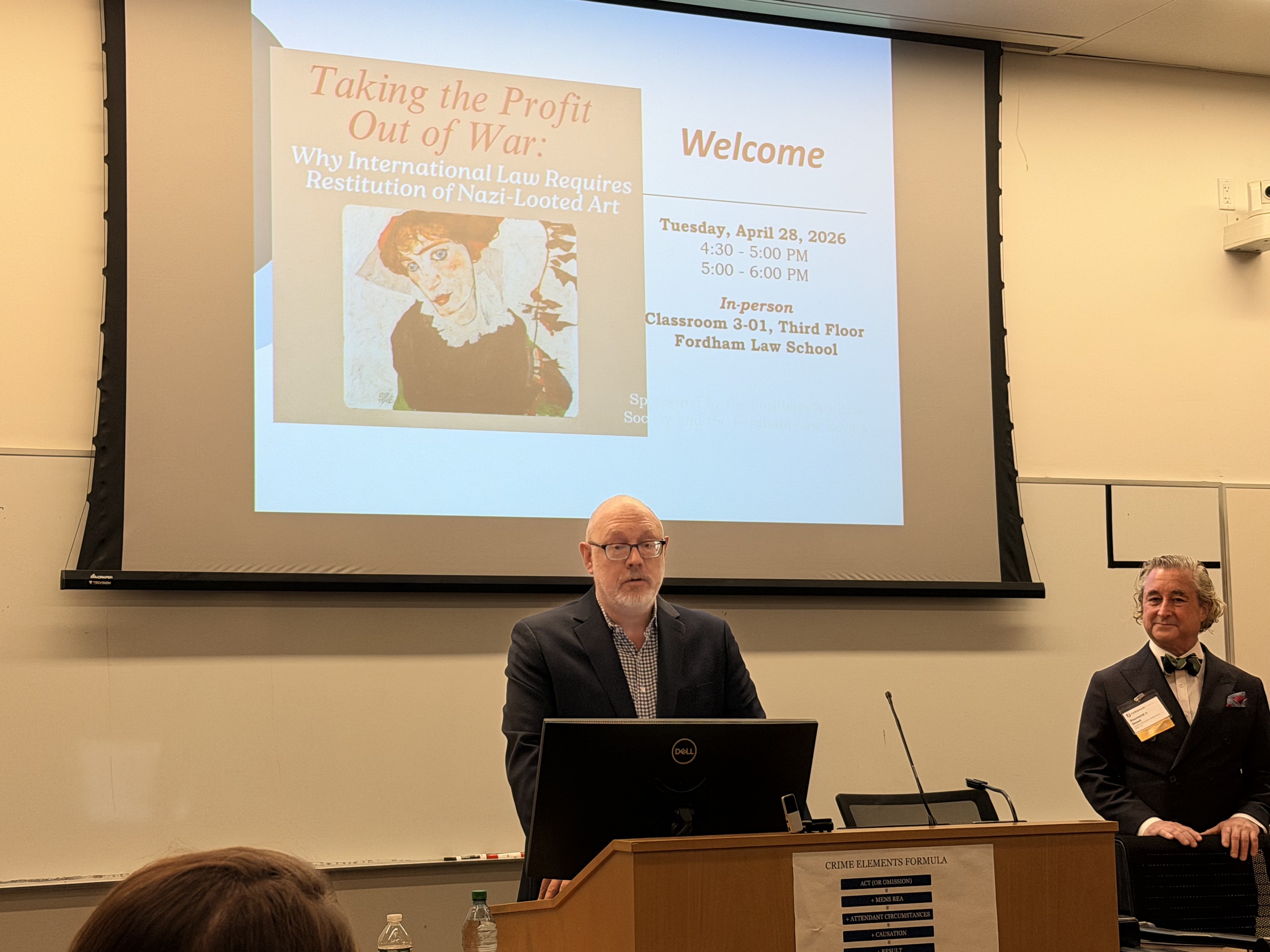
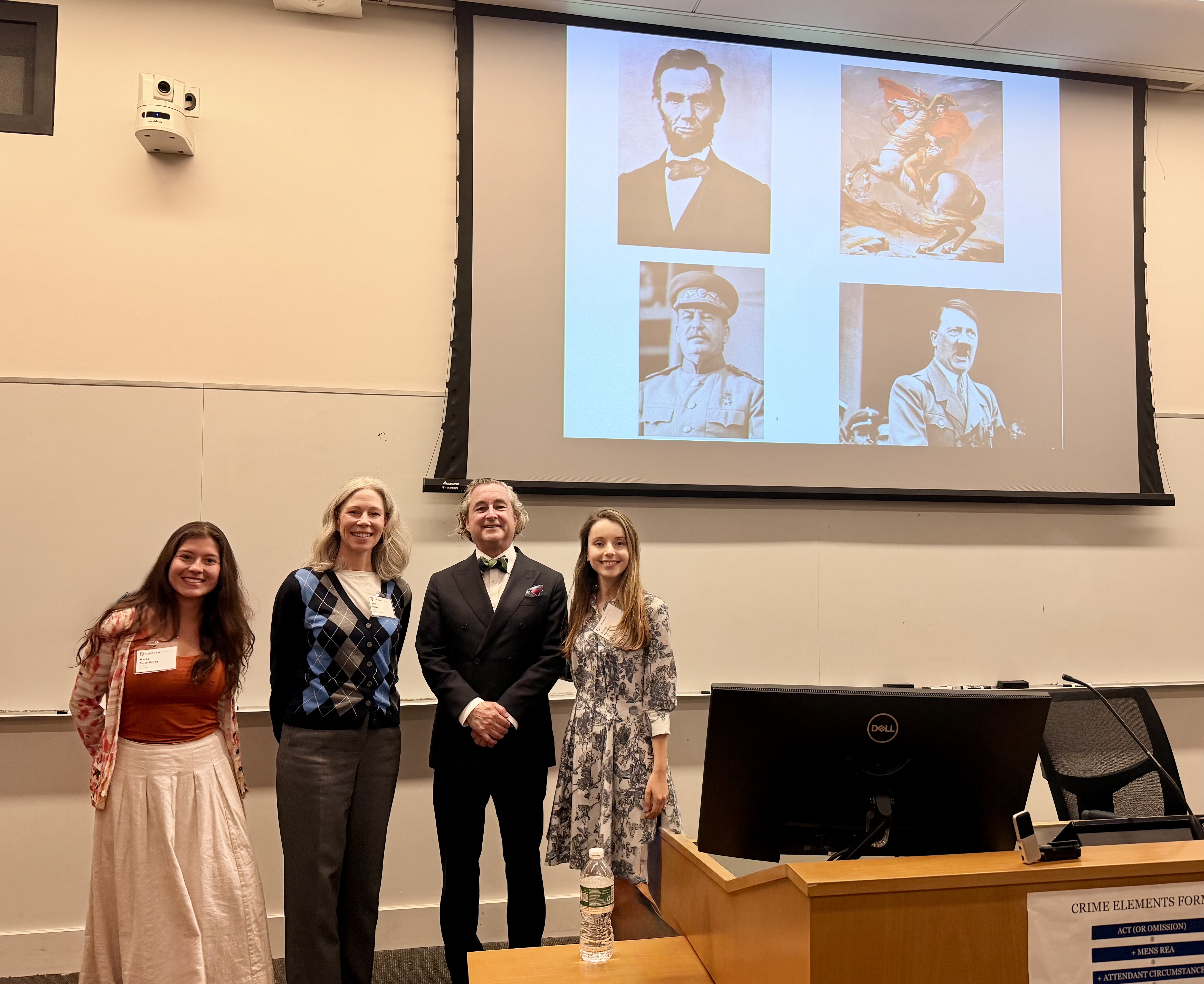
The Fordham Art Law Society and Fordham Law Review hosted Taking the Profit Out of War on April 28, featuring Ray Dowd of Dunnington Bartholow & Miller LLP, a leading practitioner in Nazi-looted art litigation. Drawing on over two decades of experience representing Holocaust victims’ families, Mr. Dowd presented a compelling argument that restitution is not merely a moral aspiration but a requirement grounded in longstanding principles of international law. His talk traced the legal and historical frameworks governing wartime looting, from the 1907 Hague Convention’s prohibition on pillage and protection of private property to post–World War II agreements that explicitly committed Allied nations to identify, recover, and return looted assets. Yet despite these formal commitments, Mr. Dowd emphasized that enforcement has been inconsistent at best, with many European jurisdictions effectively closing their courts to restitution claims and failing to utilize available police powers to recover stolen works.
A central focus of the discussion was the evolving legal landscape in the United States, particularly recent developments surrounding the Holocaust Expropriated Art Recovery (HEAR) Act. According to Mr. Dowd, new amendments significantly strengthen claimants’ ability to pursue restitution by reopening statutes of limitations and eliminating procedural defenses that have historically barred claims before they could be heard on the merits. These changes may have immediate implications for several high-profile cases, including long-running disputes against foreign sovereigns such as Spain and Austria. More broadly, Mr. Dowd positioned these developments as part of a larger shift toward aligning domestic legal practice with international obligations—though he cautioned that significant gaps remain, particularly in Europe, where access to judicial remedies is still limited.
Beyond doctrine, the lecture engaged with the structural question at the heart of the issue: whether the international legal system is capable of removing the economic incentives of war. Mr. Dowd argued that as long as looted cultural property continues to circulate in the global art market without consequence, the prohibition on pillage remains hollow. He called for a more robust enforcement regime, including greater involvement by prosecutors and law enforcement agencies, noting that isolated efforts—such as recent seizures of Nazi-looted objects—demonstrate what is possible but remain the exception rather than the rule. Ultimately, the talk framed Nazi-looted art restitution not as a closed chapter of history, but as an ongoing test of whether legal systems will uphold the protection of private property and cultural heritage in both principle and practice.


Leave a Reply